
Breast lift vs implants: How to tell which one you need
If your breasts have dropped but the size is right, you need a breast lift. If the position is good but you want more fullness, you need implants. If you have lost both position and volume, the answer is usually both. When patients compare breast lift vs implants, the deciding factors are nipple position relative to the breast fold, skin elasticity, and remaining breast tissue, which is why an in-person examination is the only way to confirm which applies to you.
Some women who ask about breast implants are really asking about a breast lift. Others need both, and a smaller group needs a reduction. If you are comparing breast lift vs implants, the first step is working out what has actually changed in your breast size, shape, and position.
The difference comes down to one question: has your breast lost position, volume, or both? A lift repositions existing breast tissue and removes excess skin, which can correct sagging or drooping breasts. A breast implant adds volume. They solve different problems, and choosing the wrong one can leave you disappointed with the result.
This guide explains how a board certified plastic surgeon tells those problems apart, what each cosmetic breast surgery option does, and how to arrive at your consultation knowing which procedure aligns with your goals.
Breast lift or implants: which one do you need?
It depends on what has changed. A breast lift, or mastopexy, suits you if your breasts sit lower but the size is right. Breast augmentation may suit you if nipple position and skin support are adequate and you want more fullness. If you have lost both position and volume, a lift with implants is often recommended. If the weight of larger breasts is causing the sagging, a breast reduction may be the better fit.
| If your concern is | The procedure is usually |
|---|---|
| Your breasts sit lower than they used to, but the size is right | Breast lift (mastopexy) |
| Your size is smaller than you want, but the position is good | Breast augmentation |
| Both position and fullness have been lost | Lift with implants |
| Weight and size are the cause of the sagging | Breast reduction |
The rest of this page explains how a surgeon decides which row you are in.
How do surgeons measure sagging breasts?
Surgeons grade sagging, called ptosis, by where the nipple sits relative to the inframammary fold, the breast crease beneath the breast [2]. Mild sagging places the nipple at the fold, moderate sagging places it below the fold, and severe sagging places it below the fold and at the lowest, most dependent point of the breast. The grade strongly influences which operation and which incision pattern are appropriate.
You cannot judge this by eye alone, which is why surgeons use a set grading system.
| Grade | Where the nipple sits | Often treated with |
|---|---|---|
| Grade I (mild) | At the level of the fold, still above the lowest point of the breast | Augmentation alone, or a periareolar lift |
| Grade II (moderate) | Below the fold, but still above the lowest point of the breast | Vertical lift |
| Grade III (severe) | Below the fold and at the lowest, most dependent point of the breast | Anchor lift (wise pattern) |
| Pseudoptosis | At or above the fold, but the lower breast has dropped beneath it | Augmentation, skin removal, or both |
Pseudoptosis is easy to misread. The breast looks like it has fallen, but the nipple has not moved. It can appear after pregnancy, breastfeeding, or weight loss, when glandular tissue shrinks and the skin does not shrink with it. This is also the grade where implants alone can be the right answer, which is the opposite of the general rule.
You can approximate your own grade in a mirror. Find the crease under the breast and note whether the nipple sits above it, level with it, or below it. That tells you roughly where you fall. It does not replace an examination, because skin elasticity, tissue thickness, and nipple position relative to the chest wall all change the plan.
What does a breast lift procedure do?
A breast lift, also called breast lift surgery or mastopexy, removes excess skin and repositions the nipple and breast tissue higher on the chest. It can reshape sagging breasts using what is already there rather than adding volume. A lift will not make your breasts larger, and because it removes skin, your breasts can look slightly smaller even when little or no breast tissue is removed.
A lift is the right operation when you are content with your size out of a bra and want that shape back where it used to sit. By removing excess skin and tightening the shape, it may restore a more youthful contour. You can see what the result can look like in our breast lift photo gallery, and read more on the breast lift procedure page.
Which incision patterns does breast lift surgery use, including the anchor lift?
The incision pattern follows the grade of sagging:
- Periareolar: a circular incision around the areola, for mild sagging
- Vertical: a circle plus a line down to the fold, often called a lollipop, for moderate sagging
- Wise pattern: adds a horizontal incision along the fold, often called an anchor lift, for severe sagging
More sagging means more skin removal, and more skin removal means a longer scar. This trade-off surprises many people, so it helps to understand it before your consultation. Our guide to vertical, crescent, and periareolar breast lift scars shows what each pattern looks like.
What do breast implants do, and what does breast implant surgery involve?
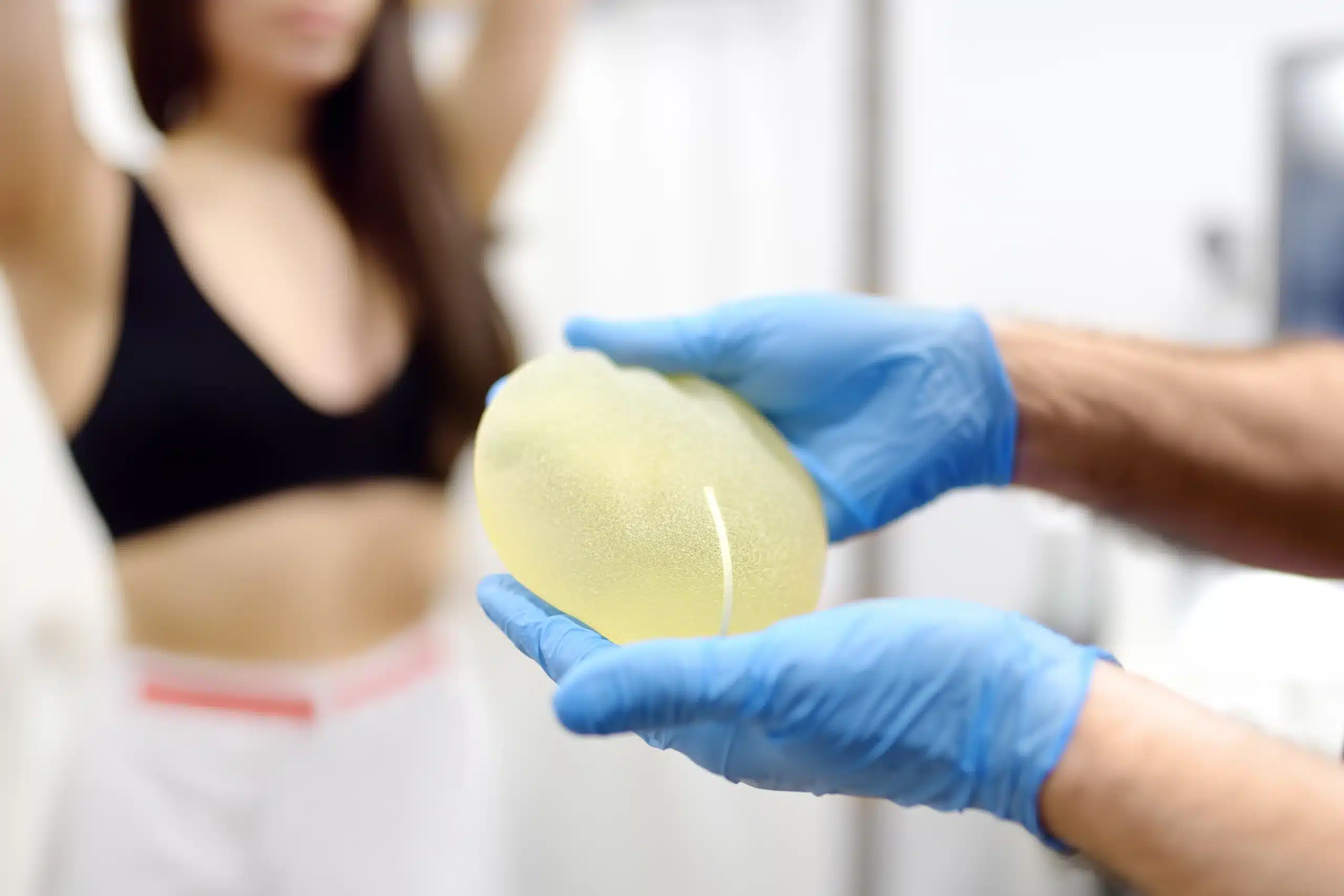
Breast augmentation, sometimes called breast enhancement, adds volume with breast implants. It restores lost fullness or increases breast volume, particularly in the upper part of the breast, where volume is often lost first. Implants do not lift the breast on their own. Placed in a breast with significant sagging, an implant adds weight to tissue that is already struggling to hold its position.
There is one exception, and it is pseudoptosis. When the nipple is still correctly positioned and the issue is a deflated lower breast, an implant can fill the skin and restore shape without a lift. You can read more about breast implants in NYC on our breast augmentation page.
How do you choose implants for breast enhancement?
Breast implants are medical devices, and breast enhancement involves two main choices. Implants are filled with either silicone gel or saline, so you will hear them called silicone implants and saline implants. Implant placement is the second choice: they can sit above or below the chest muscle. Your surgeon will recommend a combination based on how much natural breast tissue you have to cover the implant, your skin elasticity, and your aesthetic goals.
Breast augmentation vs breast lift: what is the difference?
A breast lift changes position and removes excess skin. Breast augmentation changes volume by adding an implant. A lift leaves your size roughly the same, while augmentation leaves your breast position largely unchanged. Which one you need depends on whether your concern is a lower breast, a smaller breast, or both. A surgeon confirms this by examining your skin, breast tissue, and nipple position.
| Breast lift | Breast augmentation | |
|---|---|---|
| Main goal | Restore breast position | Add or restore volume |
| Removes excess skin | Yes | No |
| Moves the nipple higher | Yes | No |
| Changes cup size | Usually not, and may look slightly smaller | Yes |
| Typical scar | Around the areola, with or without a vertical line and a fold incision | Small incision in or near the breast fold, around the areola, or elsewhere, chosen with your surgeon |
When do you need both a breast lift and implants in NYC?
Many women who have been through pregnancy or significant weight loss have lost both position and fullness, and lost fullness in the upper breast is easy to miss. For them, a lift with implants, sometimes called an augmentation mastopexy, is often recommended. The implant helps restore lost volume and the lift places the breast where it belongs. It is more complex than either operation alone because your surgeon changes volume and skin together.
Ask any surgeon how often they perform the combination and how they plan the two parts against each other. A combined lift and augmentation can be more complex than either procedure alone, and revision surgery may be more likely in some patients [3].
Some patients ask whether a combined procedure or two separate surgeries is better. Staging the operations means a second recovery and a second round of anesthesia, so most patients prefer to have both done at once.
“Almost always the procedure is done in one stage. If the patient has had multiple prior surgeries, it may be safer to stage the procedure and have one procedure ahead of the other, approximately three months apart.” – Dr. Kevin Tehrani, MD, FACS
When is breast reduction the answer?
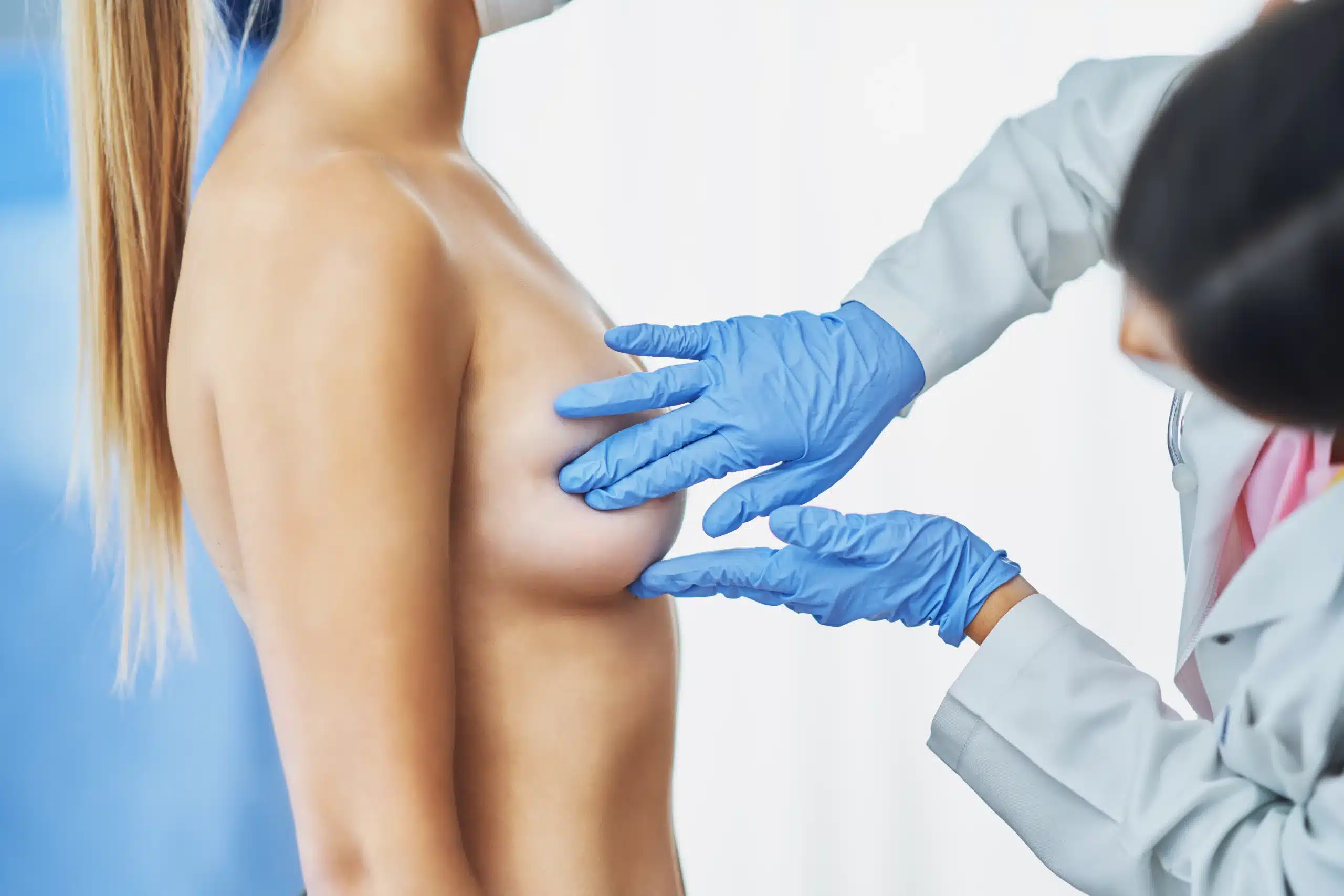
If your breasts are large and their weight is pulling the tissue down, a lift alone may not hold. A breast reduction removes volume while lifting and reshaping at the same time, so it addresses the size and the sagging together. Many patients are surprised that a reduction is also a lift, and that it can ease the shoulder, neck, and back symptoms that brought them in.
If larger breasts are your main concern, ask about reduction at your consultation. Learn more on our breast reduction page.
What actually causes breasts to sag?
Breast sagging comes from pregnancy, age, genetics, significant weight loss, and smoking. Skin loses elasticity over time, and the ligaments that support breast tissue stretch. Larger breasts tend to sag sooner because more weight acts on the same supporting structures. Breastfeeding, despite a common belief, has not been shown to cause sagging on its own.
Does pregnancy or breastfeeding cause sagging?
Pregnancy changes the breast, and the number of pregnancies is a recognized risk factor for sagging. Breastfeeding itself is not an independent risk factor for breast ptosis. Pregnancy, age, and smoking history are more consistently associated with sagging. [1]
Some women worry that nursing will ruin the breast. Current evidence does not support the concern that breastfeeding alone causes breast sagging.
How does weight loss affect your breasts?
Significant weight loss removes fat from the breast but leaves the skin behind. The result is a breast that has lost volume and position at once, often with noticeably loose skin. This group often needs a lift, and frequently a lift with implants, because restoring position alone can leave the upper breast empty. Results tend to hold better once your weight has been stable for several months.
What do age, genetics, and smoking change?
Skin loses elastin with age, and the ligaments that support breast tissue stretch over time. This is natural aging, and sagging in your twenties or thirties is not unusual and does not mean something went wrong. Breast shape, skin elasticity, and tissue composition are influenced by genetics as well as age, weight changes, pregnancy, and lifestyle factors.
Smoking is also associated with ptosis [1]. It degrades elastin, and it raises surgical risk and slows wound healing, which is why surgeons ask patients to stop well before an operation.
What does not work to lift breasts?
No cream, exercise, or bra restores breast position. The chest muscle sits behind the breast, and strengthening it does not lift the tissue in front. A well-fitted bra improves how your breasts sit while you wear it, and nothing more. Most non-surgical products do not produce a meaningful, lasting change in breast position.
What are the risks of breast lift and breast implant surgery?
Both surgical procedures carry risks, including bleeding, infection, scarring, asymmetry, and changes in breast or nipple sensation. Breast implants add risks such as capsular contracture, where scar tissue tightens around the implant, implant rupture or deflation, and the possibility of future revision surgery [4][5]. Lifts add the risk of wider or more visible scarring [6]. Your risks vary with your health and your plan.
Changes in nipple sensation can be temporary or, in some patients, lasting. Poor wound healing is more likely in smokers. Breast implants are not lifetime devices, and many patients need replacement or removal at some point. As with other cosmetic surgeries, neither procedure stops future change, because pregnancy, weight change, and age continue to act on the breast afterward. An experienced surgeon will go through the risks that apply to you, and what outcome is realistic, before you decide.
What does recovery look like after a breast lift or implants?
Recovery varies by procedure and by patient.
“Typical recovery for a breast lift with implants is anywhere from three days to one week. Most patients take off a full week if they’re having a breast lift. Breast augmentation is typically less time needed for recovery. For example, for Preserve, it’s about 1 to 2 days.” – Dr. Kevin Tehrani, MD, FACS
Swelling settles over several weeks, and the final shape can take a few months to appear. Implants settle gradually, and scars mature and fade over time, though they do not disappear.
Return to exercise depends on where the implant sits. Your surgeon will confirm when you are cleared.
“If the implants are placed under the muscle, there are no chest exercises up until two months. For most patients, where the implants are placed over the muscle, that’s reduced to three weeks to a month.” – Dr. Kevin Tehrani, MD, FACS
Support garments and scar care are where recovery plans differ most between practices. At Aristocrat, the protocol is detailed:
“Following a breast lift or augmentation, I recommend wearing a supportive, non-underwire SHAPERX post-surgical bra for 23 hours a day during the first month, transitioning to 12 hours a day during the second month. However, for patients undergoing a Preserve breast augmentation, recovery is significantly faster and a surgical bra is only needed for a few weeks.
For incision care, we initially recommend an antibacterial ointment during the early healing phase. Once the incisions are completely closed and healed, we transition to our own APS medical-grade scar cream. Depending on the patient’s healing progress, we may incorporate Silagen medical-grade silicone scar sheets, typically alternating between the cream and sheets. For breast lift patients, we incorporate a carboxy mask, which uses carbon dioxide to stimulate local circulation and improve oxygen delivery to the skin. Consistent scar care and sun protection are essential, as scars continue to mature and fade over the following 6 to 12 months.” – Dr. Kevin Tehrani, MD, FACS
Scars fade with that kind of care, but they do not disappear. Any surgeon who tells you they vanish completely is overselling.
How much does a breast lift or augmentation cost in NYC?
Your cost depends on the procedure, the implants if you use them, the incision pattern, anesthesia and facility fees, and the surgeon’s fee. A combined lift and augmentation generally costs more than either procedure alone.
“There are different types of lift. Based on the complexity of the lift and whether or not we use saline or silicone, and the type and generation of the implant, prices can vary, starting from $15,000 up to $40,000.” – Dr. Kevin Tehrani, MD, FACS
That range is a starting point, not a quote. The most reliable figure is an itemized quote after an examination, which shows what is included and what is billed separately.
When you compare quotes, ask what each one covers. A lower starting figure can simply mean more charges come later.
How can you see your result before you decide?
Aristocrat uses VECTRA 3D imaging during your consultation to simulate a projected result.
“We do VECTRA imaging for breast augmentation and lift in all locations, and have a discussion with the patient about whether one operation is better suited for them or a combination of both.” – Dr. Kevin Tehrani, MD, FACS
For patients weighing a lift against a lift with implants, the simulation lets you see the difference between the two options. A simulation is an estimate, not a guarantee, and your actual result depends on your anatomy and how you heal.
Browse real cases in our breast lift photo gallery. Individual results vary.
Where can you get a breast lift or breast augmentation in NYC?
Whether you want a breast lift in NYC, breast augmentation in Manhattan, or either procedure on Long Island, the first step is the same: an in-person examination with Dr. Kevin Tehrani. He will assess your nipple position, skin elasticity, and breast tissue, then recommend a lift, implants, or both.
Aristocrat has offices in Manhattan, Great Neck on Long Island, and Southampton, so you can book a consultation in New York City or closer to home.
The bottom line
In the breast lift vs implants decision, a lift moves tissue, implants add volume, and reduction removes it. The right choice depends on your desired outcome. Many women need one, some need two, and the only reliable way to know is an examination of your skin elasticity, breast tissue, nipple position, and overall breast appearance. If you are unsure which row of the table you fall in, that is a good reason to book a consultation, not a reason to guess.
Considering plastic surgery for your breasts, whether a breast lift, breast augmentation, or both, in NYC? Schedule your consultation with Dr. Kevin Tehrani, MD, FACS, to find out which approach fits your goals.
Frequently asked questions
Can sagging breasts be lifted without implants?
Yes. A lift on its own repositions the breast and is the right choice when you are happy with your volume. Implants are added when fullness has been lost as well as position, which is common after pregnancy or weight loss.
Do breast implants lift sagging breasts?
Not on their own. Implants add volume, and in a breast with significant sagging they can add weight to tissue that is already low. The exception is pseudoptosis, where the nipple is well positioned and an implant can fill a deflated lower breast.
What is the pinch test?
A surgeon pinches the tissue at the top of the breast to judge how much soft tissue covers the chest wall. Thin coverage makes an implant edge more likely to be visible or palpable, and it influences both implant choice and placement.
What are the disadvantages of a breast lift?
Scarring is the main one, and the scar is longer the more sagging there is to correct. A lift does not add volume, and it does not stop future change. Changes in nipple sensation are possible.
How much does a breast lift cost?
At Aristocrat, Dr. Tehrani says pricing starts at $15,000 and can reach $40,000, depending on the complexity of the lift and the type and generation of implant, if used. An itemized quote after your examination shows exactly what is included.
Should I wait until I am finished having children?
Future pregnancies can change the result, so patients who plan to have more children soon are often advised to wait. That is a judgment made case by case, and many patients choose to proceed.
Does breastfeeding cause sagging?
Research to date has not shown that it does. Pregnancy, age, and smoking are linked to breast sagging.
How long do the results last?
A lift repositions the breast, but it does not pause aging. Many patients keep the improvement for years. Weight change and further pregnancies can shorten that.
Medical References
- Rinker B, Veneracion M, Walsh CP. Breast ptosis: causes and cure. Ann Plast Surg. 2010;64(5):579-584. doi:10.1097/SAP.0b013e3181c39377. PMID: 20354434.
- Toomey AE, Cape JD. Mastopexy (Breast Lift). In: StatPearls. Treasure Island, FL: StatPearls Publishing; updated December 11, 2024. https://www.ncbi.nlm.nih.gov/books/NBK610682/
- Stevens WG, Macias LH, Spring M, Stoker DA, Chacón CO, Eberlin SE. One-Stage Augmentation Mastopexy: A Review of 1192 Simultaneous Breast Augmentation and Mastopexy Procedures in 615 Consecutive Patients. Aesthet Surg J. 2014;34(5):723-732. doi:10.1177/1090820X14531434. PMID: 24792479.
- U.S. Food and Drug Administration. Risks and Complications of Breast Implants. https://www.fda.gov/medical-devices/breast-implants/risks-and-complications-breast-implants
- U.S. Food and Drug Administration. Things to Consider Before Getting Breast Implants. https://www.fda.gov/medical-devices/breast-implants/things-consider-getting-breast-implants
- di Summa PG, et al. Systematic review of outcomes and complications in nonimplant-based mastopexy surgery. J Plast Reconstr Aesthet Surg. 2019;72(2):243-272. doi:10.1016/j.bjps.2018.10.018. PMID: 30527707.